


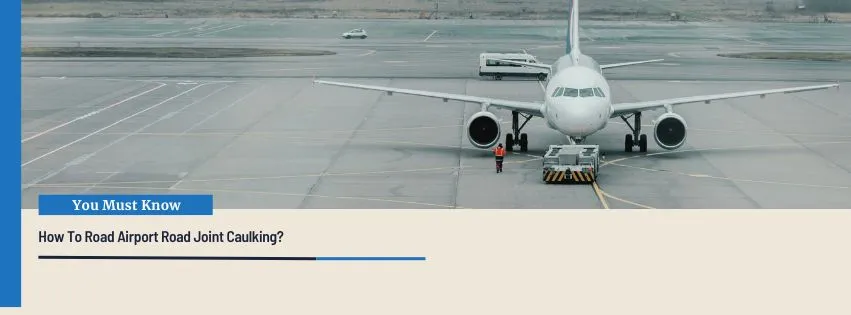
Airport concrete pavement is usually cast with high-strength cement concrete. To adapt to the thermal expansion and contraction caused by climate change and the pressure on the pavement, engineers usually use joints to reduce the pressure. However, i, rain and snow water can penetrate and cause the road panel to crack and sink.
Therefore, there are strict requirements for sealing materials for airport road joint caulking, especially in areas with strong ultraviolet rays, high temperature differences, and high humidity, where sealants are more prone to damage. Currently, the main reasons for sealant failure include poor adhesion between sealants and substrates, aging of sealants, inadequate resistance to high and low temperatures, and limited displacement ability.
What Causes Airport Road Joint Caulking Failure?
1. Bonding problem between sealants and substrates
Since concrete pavements are mostly porous materials, they are easy to absorb dust and are not easy to clean completely, causing cracks in the bonding surface between sealants and substrates.
2. Aging problem of sealants
For the reason that airport pavements have been affected by ultraviolet rays and high temperatures for a long time, The weather resistance of the sealant is very important, otherwise it is easy to cause the sealant to powder and crack.
3. The problem of sealant’s resistance to high and low temperatures
4. The problem of displacement capacity
The engineers design the concrete pavement of the airport with an 8mm joint to adapt to thermal expansion and contraction, so the sealant needs to have a strong displacement capacity to ensure the sealing of the joint.
At present, Tengyu TNS780 self-leveling silicone sealant has been used in many airport road joint caulking.
TNS780 self leveling silicone caulk is one-part, cold-applied, easy-to-use, self-leveling silicone material. It cures to an ultra-low-modulus silicone rubber upon exposure to atmospheric moisture.The cured silicone rubber remains flexible over the entire temperature range expected in pavement application.
- No tooling, less labor
- Durable
- Ideal for cold climates
- Excellent flexibility for extreme high and low temperature conditions
- Excellent flexibility for dynamic joint movement
- Bonds to most substrates without priming including aged asphalt and concrete
- Ready to use
- All season ease of application
- Good contact/adhesion with hard to reach areas
- Excellent for use on runways and tarmacs
- Jet fuel resistant
- Resistant to road salts
Tengyu’s one-stop service provides customers with corresponding solutions to problems encountered during use.