As the temperature drops, some silicone sealants actually start to bubble up? This article will discuss the reasons and solutions for sealant bubbling.
1. Reasons for silicone sealant bubble up
Commonly used weather-resistant silicone sealants are single-component sealants. When curing, they need to react with moisture in the air. Temperature and humidity have a certain effect on their curing speed. Generally speaking, the higher the temperature, the faster the reaction speed. And the higher the humidity, the faster the reaction speed. Silicone sealant bubbles usually because the relative humidity or temperature of the environment is low, the sealant cures slowly, and when the surface has not cured to a sufficient depth. If the width of the joint changes greatly, the surface of the joint will be uneven. When the sealant completely cured, the inside is actually solid, not bubbles. This situation is uniformly called bubbles up.
2. Solution to silicone sealant bubble up
Although the silicone sealant bubble up phenomenon has no effect on the performance, it will affect the appearance. So how to avoid this situation?
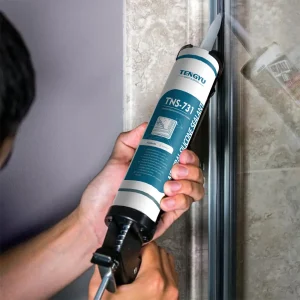
(1) Choose to construct when the temperature difference of the substrate is small and the deformation of the joint is small.
On cloudy days, seize the time to construct, because the temperature difference between day and night is small on cloudy days, the deformation of the glue joint is small, and it is not easy to bulge. On sunny days, it is recommended to use sunshade measures, such as dustproof nets, to avoid exposing the substrate to high temperatures and reduce temperature differences.
(2) Choose silicone sealant with a relatively fast curing speed, which can solve the bulging problem of most weather-resistant sealants.
(3) Choose the right time to apply sealant (construction when the panels of the facade are exposed to the sun)
(4) Use the method of secondary gluing.
First, apply 1/2 of the depth of the joint, wait for it to cure for 2~3 days and become elastic, and then apply the second layer of glue on its surface. When applying the second layer of sealant, the surface of the first layer of sealant should be clean and free of dust and other stains, otherwise the two layers of glue cannot form an effective bond.
The bubbling up of sealant is not terrible. The important thing is to find the cause and solution, so as to minimize the occurrence of bubbling. If you encounter problems in other applications, please leave a message below~